Another competition night that was very well represented! This month we had 20 members from the Intermediate section and 26 members from the Advanced section submitting two images each giving the judge 92 images to consider. It's a good job we have a comfort break after the Intermediates have been judges, critiqued and scored!
Once again there was a variety of subject but they had to be in black and white or monochrome. We had landscapes, architecture, portraits, indoor close-ups and a few abstracts among others.
I think it must be difficult for judges, they have to be critical, but in a constructive way, and to do that for 92 images - in this case! They can't (or maybe shouldn't) be too harsh on the intermediates as they are still learning their skills and don't want their enthusiasm dampened too much. They can afford, perhaps, to be more critical with the advanced members as they have 'proved' themselves worthy of the position either through qualification, distinction, employment or even 'promotion' from the intermediates.
A common theme through the critique was about the tonal range (or lack of it ... ). It is important to have black blacks and white whites, which might sound easy but when you are photographing a black cat in a coal cellar things get a little more difficult! Fortunately if you shoot in RAW you at least have the ability to boost the shadows to a point where you can see the cat and distinguish from a couple shiny eyes staring into the camera. You can also get the exposure correct in camera to achieve the same thing but there lies the difference, perhaps, between the intermediate photographer and the advanced! the same can obviously said for the white swan on a sun drenched river. You need to see the lines and texture of the feathers rather than a burnt out mass of white with no definition at all. Again, post processing can help by pulling down the highlights.
Black and white is often touted as being a good way of removing distractions from your image. This can be particularly beneficial in Street Photography where there are a multitude of distractions from bright colourful signs and vehicles to dull uninteresting street furniture (although in another project these things can be eminently desirable) that add to the scene but draw the eye away from the subject of the picture - and that is something else you have to have - a focal point. You must have a focal point that the viewer can, well, focus on and preferably one that leads the viewer to all the interesting point in the picture, although it is possible to have just one thing/item/person to look at.
And don't be afraid to include a person in the image. This can give scale and perspective and also help lead you into and through the image. A good example of this can be seen in the image on the right where you can see the person dwarfed by the building arch so it's hardly surprising that Julia Furlonger won the Intermediate section with this image entitled 'Straight Through'.
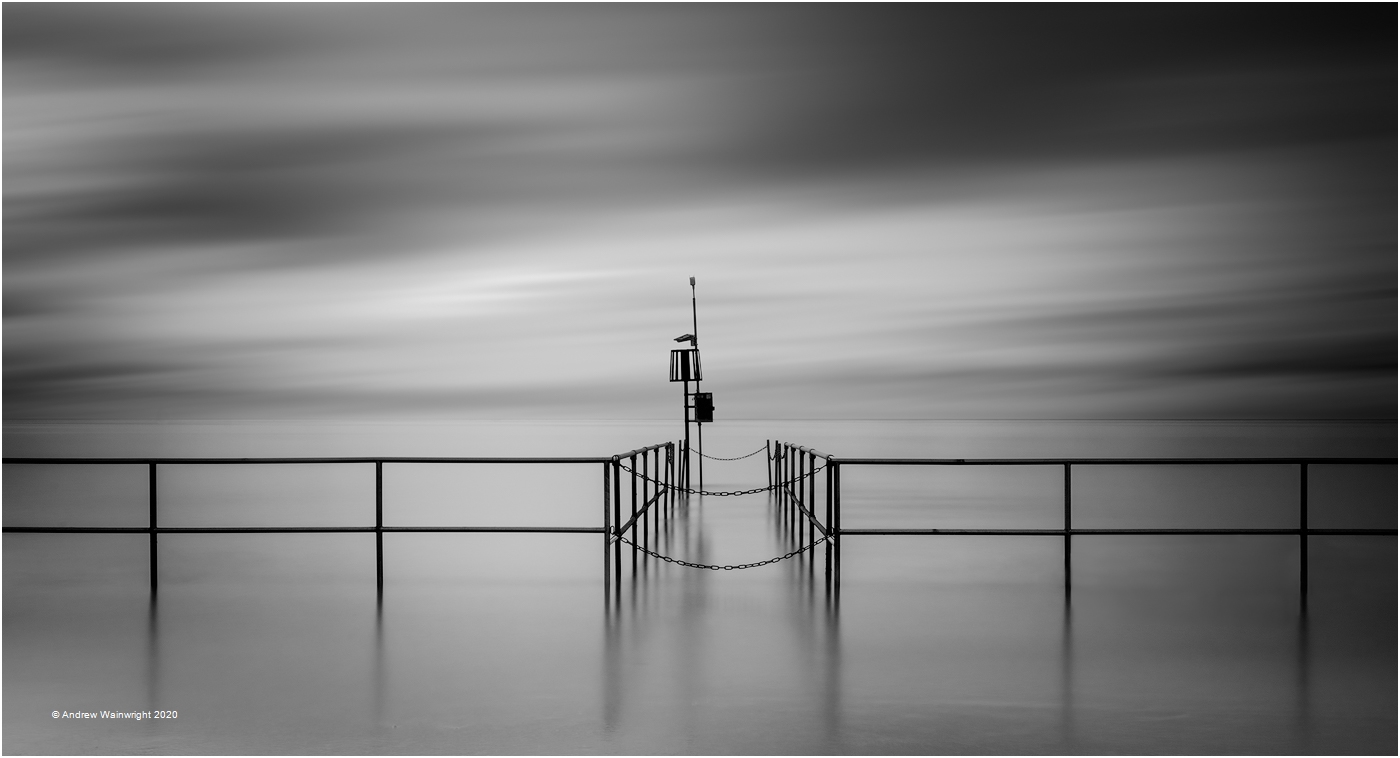
Andrew Wainwright's winning image in the Advanced section is somewhat simpler but just a captivating with the 'milky' image of the water around the iron work railings leading you to the beacon at the end of what could be a short jetty and the beacon then breaking the horizon to introduce the sky. And don't forget the two chains barring the way.
Congratulations to Julia and Andrew. And not forgetting a special thanks to Steve Roper for his time and effort in judging for us on this round.
07 December 2020.